


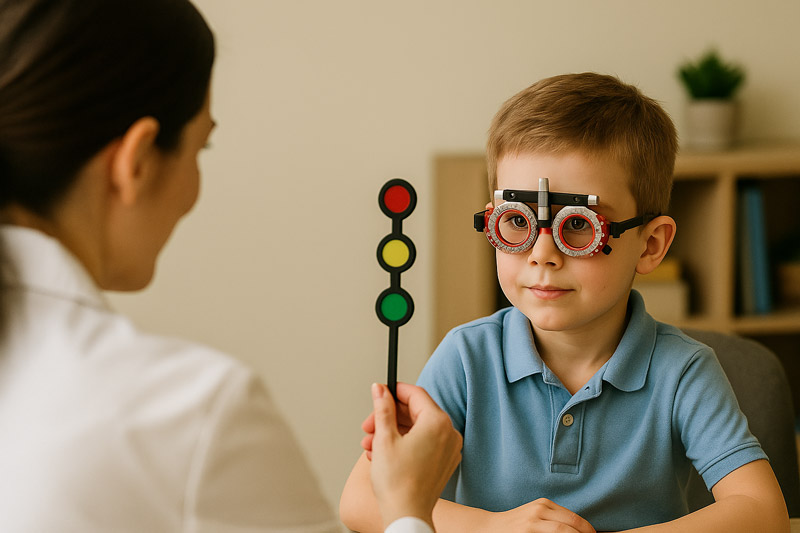

What is the Vision?
Vision is the dominant sensory system, with 80% of learning being done through the visual system.
As a child’s eyes develop, it is not uncommon for visual and perceptual problems other than simply Hyperopia (farsightedness), Myopia (nearsightedness) or Astigmatism to arise.


These issues often can’t be detected by a simple eye exam; even a child with 20/20 vision can have underlying vision problems. Many treatable vision problems mimic ADHD behaviors!


What is the Vision Therapy?
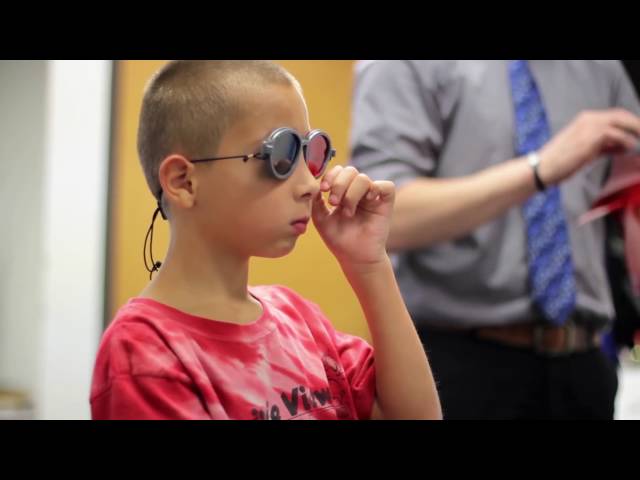
Vision Therapy is a sequence of neurosensory and neuromuscular activities individually prescribed by a doctor to develop, rehabilitate, and improve visual skills and processing.
Conditions like Amblyopia (lazy eye), Strabismus (crossed eyes), Convergence Insufficiency (eyes being unable to work together when looking at nearby objects), Accommodative (focusing) Dysfunction, and Oculomotor Dysfunction can be treated with the help of Vision Therapy. Convergence Insufficiency affects about 1 in 12 children, potentially causing headaches, double vision, and poor concentration and short attention spans for reading tasks, all of which are symptoms sometimes misdiagnosed as ADHD.
Some of these issues can relate to the eyes themselves, their movement individually and together, and their ability to focus. Eye teaming, tracking, focusing, and hand eye coordination all affect a child’s success, whether in academics, athletics, and general functioning.
Some of the symptoms include:
- Losing place while reading
- Struggle in reading
- Skipping or re-reading lines while reading
- Poor attention and concentration
- Homework being a battle
- Letter reversals
- Poor handwriting
- Difficulty riding a bike
Thankfully, our vision skills can be strengthened just like we are able to train the rest of our body.
With Vision Therapy, patients can develop their vision skills under the supervision of a doctor.
Amblyopia
Amblyopia, also known as “lazy eye”, is a vision condition caused by the brain’s inability to use both eyes as a team. As a result, the brain ignores the incoming information from one of the eyes. Even with corrective glasses or contacts, those with amblyopia tend to have reduced eyesight in one eye. If left untreated, this condition can adversely impact a child’s success in work, school, sports and social interactions, which in turn may affect their self-esteem and confidence.
Note that it is possible for a child with amblyopia to show no symptoms. However, the following may indicate the possibility of amblyopia in a child:
- Lower reading speed and comprehension
- Tripping and/or balance problems
- Poor hand-eye coordination
- Difficulty with 3D depth perception


Traditionally, amblyopia was treated using Atropine eyedrops or by patching the better-seeing eye.
However, research shows these treatments to have many limitations and negative psychosocial and emotional side effects.
Furthermore, any visual acuity improvements tend to diminish over time.
There is good news! There is an advanced treatment that is evidence-based
and proven effective for nearly all ages.
The advanced treatment:
- Corrects the binocular vision problem, eliminating the need for standard patching/drops
- Tripping and/or balance problems
- Poor hand-eye coordination
- Difficulty with 3D depth perception
Strabismus
Strabismus, or “crossed-eyes”, is a condition caused by poor alignment and muscle deficiency in the eyes. This misalignment means that the eyes may be unable to work together to provide the brain with accurate binocular visual information. As a result, a strabismic patient may experience blurry or double vision, overlapping images, and difficulty with depth perception.
Symptoms of strabismus in children may include:
- Eyes that don’t simultaneously look in the same direction
- One or both eyes crossing or turning inward
- One or both eyes turning outward
- Eyes that don’t move in tandem
- Squinting or closing one eye
- Tilting or turning the head to look at an object
- Bumping into objects, difficulty picking up small items, or any other issues with depth perception
Vision Therapy is carefully developed to correct visual-motor or perceptual-cognitive difficulties, serving as an effective, non-invasive treatment for strabismus. The sessions include fun activities, exercises, and procedures to help improve the visual system’s alignment, movements, and processing. By teaching the brain and eyes to work together, clear and comfortable vision can be achieved.
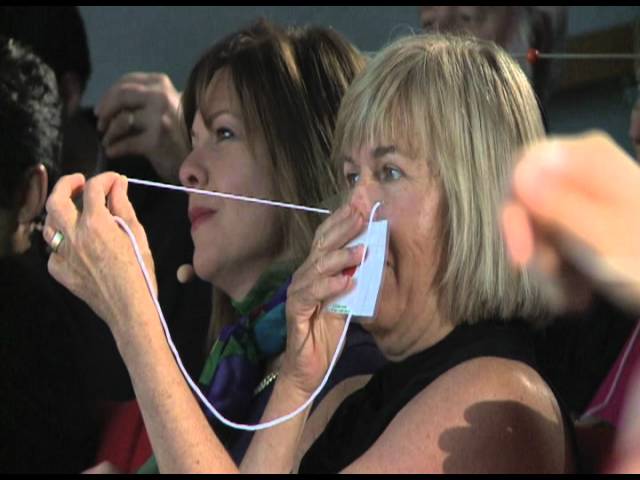
Susan R. Barry, Professor of Biological Sciences at Mount Holyoke College, South Hadley, Massachusetts talks about "Fixing My Gaze."
Concussions (mTBI)
and acquired Brain Injuries
A concussion can occur when a person experiences a sudden blow, bump or jolt to the head. Even a mild concussion can disrupt many aspects of vision due to the complexity of the visual pathway.
Research shows more than 50% of patients with concussion have visual problem that can cause:
- Headaches
- Light Sensitivity
- Double Vision
- Blurred Vision
- Dizziness
- Disorientation
- Loss of place when reading
- Eye Fatigue
- Poor concentration
- Delayed Visual Memory
- Inability to tolerate crowded places
Our advanced treatment includes:
Binocular Vision therapy
Syntonic phototherapy
Accommodation (Focusing) development
Visual Processing Development
Oculomotor Therapy
Eye-Hand Coordination Therapy


Vision Therapy for Children
Clear vision is more than having 20/20 eyesight — it is equally important to consider factors such as eye tracking (how the eyes follow an object), eye teaming (how the eyes work together), hand-eye coordination, and fixation in determining quality of vision.
Vision therapy can help to treat:
Learning-related vision problems
For children, shortcomings in their eye function and visual perception can cause symptoms such as headaches or short attention spans, which lead to reading challenges, poor grades in school, and difficulty with sports.

Convergence and accommodation problems
When the eyes can’t work well as a team or focus while reading, up-close vision can become blurry or doubled.
Amblyopia (lazy eye) strabismus (crossed eyes)
These conditions tend to occur when one eye does not communicate with the brain effectively.
Vision therapy is entirely non-invasive, consisting of a series of exercises and activities designed to “train” children’s visual skills. The entire vision therapy program typically involves weekly/bi-weekly sessions with the therapist over 6-9 months. However, since each child’s program is tailored to their specific needs, this timeframe can vary.
If you would like to learn more about KW Provision’s vision therapy services, or if you believe your child would benefit from vision therapy, feel free to call us and schedule a consultation. We look forward to seeing you and your child!


